INTRODUCING ECHOES OF LEGACY
By Elizabeth Spraker
Beginning today, the Little Falls Historical Society Museum invites you to step inside the story of our community through a new weekly series, Echoes of Legacy.
Little Falls is filled with historic homes and buildings that many of us pass every day. We recognize their porches, windows, towers, brick walls, and familiar locations, but we may not always know the people who built them, lived within them, worked behind their doors, or helped shape the community around them.
Echoes of Legacy uses these homes and buildings as gateways into the lives of the people who helped create Little Falls. Through their stories, we will meet soldiers, merchants, physicians, manufacturers, educators, public officials, religious leaders, craftsmen, philanthropists, and families whose work and service left a lasting mark upon the city.
To make the architectural story easier to follow, the series is arranged according to architectural style. As the weeks progress, we will move through Georgian, Federal, Greek Revival, Gothic Revival, Romanesque Revival, Italianate, Queen Anne, and other styles represented throughout Little Falls. Each installment will explain what to notice in the architecture, introduce the people connected with the property, and consider the legacy they left behind.
Each home will stand as its own story. Readers may begin with the first installment or join the series at any point and still discover a complete chapter of Little Falls history.
This week, we begin with the Georgian style and travel back to the eighteenth century, before the Erie Canal, before the railroads, and before Little Falls became the industrial city later generations would know.
Our first doorway into the past is the General Nicholas Herkimer Home, where architecture, family, military service, and the struggle for American independence come together.
Welcome to Echoes of Legacy—where the homes of Little Falls introduce us to the people whose lives still echo through our community today.
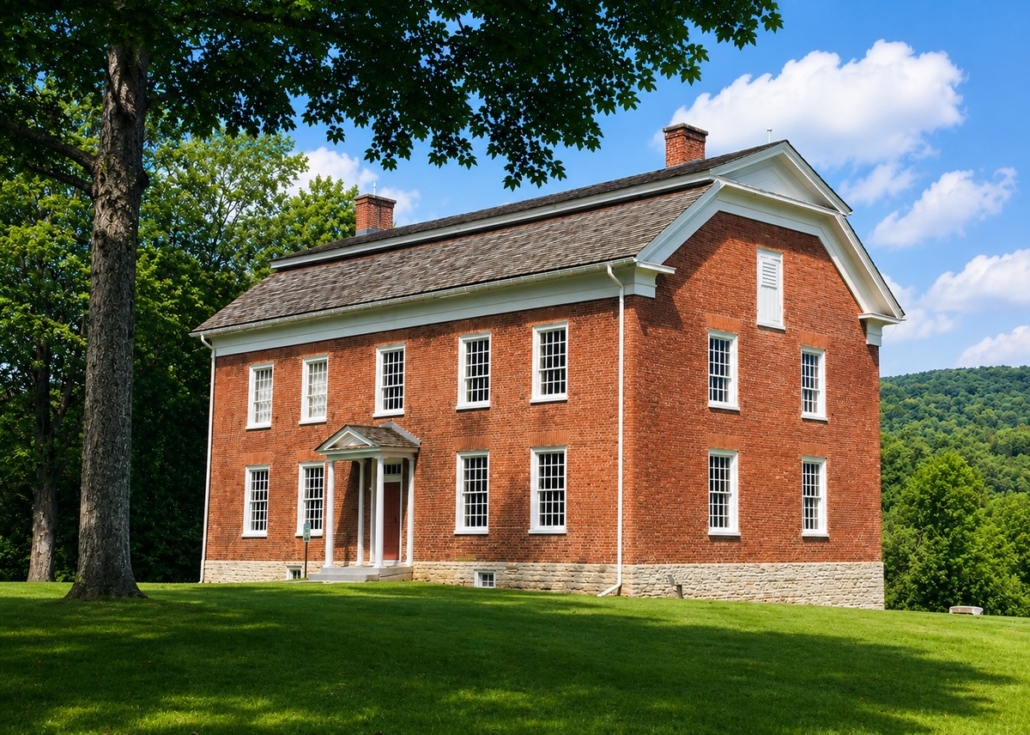
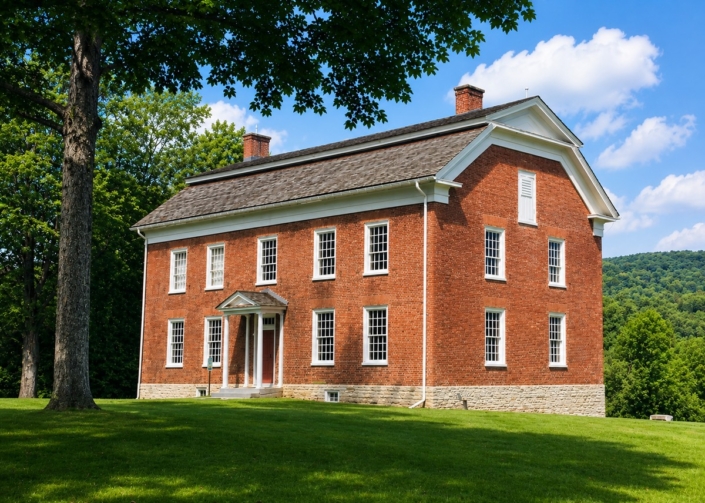
FIGURE 1.1
General Nicholas Herkimer Home, Herkimer Home State Historic Site.
Photograph © Elizabeth Spraker.
GENERAL NICHOLAS HERKIMER HOME
Herkimer Home State Historic Site
200 State Route 169, Little Falls, New York
A Testament to Revolutionary Heritage
ARCHITECTURAL OVERVIEW
Imagine traveling through the Mohawk Valley in the years before paved roads, railroads, or the Erie Canal. The landscape would have opened before you in broad stretches of farmland, woodland, and river valley. From a distance, this large brick residence would have stood out immediately—solid, orderly, and far more impressive than the modest log cabins and timber-frame homes scattered across the frontier.
The General Nicholas Herkimer Home was not simply a place to live. It stood at the center of a prosperous working estate established on approximately 500 acres of the Fall Hill Patent, granted to Nicholas Herkimer in 1752. Around the house stretched cultivated fields, barns, livestock, agricultural buildings, gardens, and apple trees that supported both the household and the commercial activities of the estate. From its elevated position above the Mohawk River, the home overlooked a landscape that reflected both agricultural prosperity and the strategic importance of this location along one of the Mohawk Valley’s principal travel corridors.
In the eighteenth century, a residence of this size and quality would have made a powerful impression. Many visitors would likely have regarded it as a manor house—not because it resembled the grand estates built in later centuries, but because few homes on the colonial frontier matched its scale, brick construction, or commanding setting. Before the brick mansion was built, Herkimer and his family first established a log cabin nearby, reflecting the gradual transformation of the property from a frontier farmstead into one of the region’s most substantial estates.
Now look closely at the façade.
The beauty of the home does not come from elaborate decoration. Instead, it comes from order. The windows are arranged evenly on either side of the centered entrance, creating the calm balance associated with Georgian architecture. Imagine an invisible line running through the middle of the doorway: the openings on one side answer those on the other, giving the entire front a sense of harmony and quiet dignity.
This symmetry was not accidental. Georgian builders admired the classical ideals of proportion and balance drawn from the architecture of ancient Greece and Rome. Those ideas traveled through Great Britain and eventually reached the American colonies, where they were adapted to local materials and the practical needs of frontier life.
The brickwork reveals another important part of the home’s story. Brick was expensive and labor-intensive to produce during the eighteenth century. Building with it required money, planning, skilled masons, and access to materials. Historical research indicates that the construction of the residence likely relied, in part, on the labor of enslaved African men owned by Herkimer, whose work formed part of the larger effort required to build and maintain an estate of this scale. The walls were laid in English bond, with alternating rows of headers and stretchers creating both strength and visual rhythm. Even the flat brick arches above the windows show the precision expected from craftsmen working on a residence of this importance.
Above the walls rises the distinctive gambrel roof. Its lower slope is steep, while the upper slope is gentler. This shape allowed more usable space beneath the roof without making the building appear excessively tall. In practical terms, it gave the household additional room while preserving the balanced proportions of the exterior. More than two centuries later, the roof remains one of the home’s most recognizable features.
The windows also deserve attention. Their orderly placement reinforces the symmetry of the façade, but they served practical needs as well. Before electricity, they brought daylight into the rooms. During warmer months, they allowed air to move through the house. In a Georgian home, even practical features were arranged with care so that usefulness and beauty worked together.
Inside, the same sense of order continued. A central hallway organized the rooms on either side, creating a balanced arrangement for daily family life, household work, and the reception of guests. The plan reflected both comfort and social standing while allowing the home to function efficiently as the center of a busy estate.
Yet the story of the Herkimer Home cannot be understood by looking at the building alone. This was never an isolated residence placed simply for appearance. It belonged to the surrounding land. Crops were planted and harvested, livestock was raised, goods were stored, and labor unfolded across the property from morning until night. Family members, hired workers, and enslaved men and women all contributed to the daily operation of the estate, each playing a role in sustaining the household and its agricultural and commercial activities. The home, barns, fields, river, and roads worked together as part of one living landscape.
Today, the General Nicholas Herkimer Home remains one of the finest surviving Georgian residences in the Mohawk Valley. Although only about 160 acres of the original estate are preserved today as the Herkimer Home State Historic Site, the house still conveys the scale, permanence, and ambition of one of the region’s most important eighteenth-century properties. Its balanced façade, carefully laid brick, gambrel roof, and commanding setting continue to speak of prosperity, discipline, and endurance—but architecture tells only the beginning of the story.
Within these walls lived a farmer, landowner, neighbor, and community leader whose courage would later carry his name far beyond the Mohawk Valley. To understand why this home matters, we must now meet General Nicholas Herkimer—the man whose life, and the lives of all who lived and labored on this estate, gave these walls their lasting place in history.
LIFE WITHIN THESE WALLS
c. 1764–Present
Duty, Courage, and Leadership on the Mohawk Frontier
The story within the Herkimer Home begins long before the Battle of Oriskany. Here, Nicholas Herkimer lived as a farmer, landowner, neighbor, and trusted community leader, shaped by the responsibilities of life along the Mohawk frontier.
The courage for which he would later be remembered did not emerge in a single moment. It grew through years of work, judgment, service, and commitment to the people and land around him.
To understand the general who remained on the battlefield beneath the beech tree, we must first understand the man whose character was formed within these wall.
GENERAL NICHOLAS HERKIMER (1728–1777)
Landowner, Militia Leader, and Revolutionary War Hero
Nicholas Herkimer was born in 1728 into a German Palatine family, part of the large wave of immigrants who settled the Mohawk Valley during the early eighteenth century. His family belonged to a generation that built farms, raised families, established churches, and created new communities in a landscape that was still difficult, isolated, and often uncertain.
From an early age, Nicholas would have understood that life in the valley depended upon hard work, sound judgment, and cooperation. Farms had to be cleared from forested land. Roads were rough, travel was slow, and neighbors often relied upon one another in times of illness, danger, poor harvests, or conflict. These experiences shaped the practical strength and steady character for which he later became known.
As an adult, Herkimer became one of the most successful landowners in the upper Mohawk Valley. Through inheritance, careful management, and additional land purchases, he developed a prosperous agricultural estate. Yet his influence extended far beyond his own property. He became known as a man whose judgment could be trusted and whose leadership carried weight throughout the surrounding settlements.
Herkimer’s prosperity, however, was also supported by enslaved labor. Records indicate that he was one of the largest slaveholders in the Mohawk Valley and may have enslaved as many as thirty-three people at different times. These individuals were legally treated as property and compelled to work without freedom or compensation.
Their labor helped sustain the large agricultural estate and the commercial activities connected to the property. Local historical research suggests that enslaved workers may also have helped construct the brick residence and portage boats and goods around the Little Falls rapids. Although the surviving records reveal little about their names, families, or individual experiences, their work contributed directly to the household, the estate, and the wealth associated with the Herkimer property.
Recognizing this history does not diminish Herkimer’s courage at the Battle of Oriskany. Instead, it allows the home to tell a fuller and more honest story—one that remembers both the Revolutionary leader whose name was preserved and the enslaved people whose labor was essential to life on the estate, but whose voices were seldom recorded.
The Mohawk Valley of his time was home to people of many backgrounds. German, Dutch, and English families lived alongside the Haudenosaunee, whose presence in the region reached back generations. Trade, diplomacy, friendship, and mutual dependence shaped daily life, but those relationships became increasingly strained as tensions between Great Britain and the American colonies grew.
When the Revolution began, the conflict divided more than governments and armies. It divided neighborhoods, churches, friendships, and families. Loyalists and Patriots often lived side by side, and in some cases, members of the same family supported opposing causes. In the Mohawk Valley, the war became deeply personal.
Herkimer accepted increasing responsibility within the local militia and was eventually appointed Brigadier General of the Tryon County Militia. He was not a professional soldier in the modern sense. He was a landowner, farmer, and community leader called upon to defend the people and settlements of the valley he knew so well.
His greatest test came in the summer of 1777.
British forces under General Barry St. Leger advanced through the Mohawk Valley with the intention of capturing Fort Stanwix and supporting the larger British campaign moving south from Canada. Their force included British regulars, Loyalists, and Mohawk warriors allied with the Crown.
When word reached the valley that Fort Stanwix was under siege, Herkimer gathered nearly eight hundred militiamen and began marching westward to assist the fort. Many of the men who followed him were not career soldiers. They were farmers, tradesmen, neighbors, and relatives who had left their homes to protect the communities where their families lived.
On August 6, 1777, as the militia moved through a wooded ravine near Oriskany Creek, they were suddenly ambushed.
The fighting was fierce and chaotic. Smoke filled the trees, musket fire echoed through the ravine, and men found themselves facing opponents they sometimes knew personally. Early in the battle, a musket ball struck Herkimer, shattering his leg and killing his horse.
His men attempted to carry him away, but Herkimer refused to leave the field. He ordered them to place him beneath a beech tree, where he sat upon his saddle and continued directing the militia while the battle raged around him.
That image has become inseparable from his story: wounded, surrounded by violence, yet calm enough to continue leading his men. His composure gave courage to those around him and helped the militia hold its ground during one of the bloodiest engagements of the American Revolution.
Although the Battle of Oriskany brought terrible losses, the resistance of Herkimer and his men helped disrupt the British campaign in the Mohawk Valley. Together with the defense of Fort Stanwix, their efforts contributed to the failure of the broader British strategy and helped prepare the way for the American victory at Saratoga later that year.
After the battle, Herkimer was carried back to his home overlooking the Mohawk River. There, surgeons amputated his wounded leg in an attempt to save his life. For a short time, he appeared to be recovering, but complications followed.
On August 16, 1777, ten days after the Battle of Oriskany, Nicholas Herkimer died at the age of forty-nine.
He did not live to see American independence, but his courage secured his place in the history of the Mohawk Valley and the nation. His story has been remembered not only because he was a general, but because he remained steady when others depended upon him most.
Within this home lived a man whose life had been shaped by the land, the community, and the responsibilities of frontier leadership. When the moment came, those same qualities carried him from the quiet order of his estate into one of the most difficult battles of the Revolution.
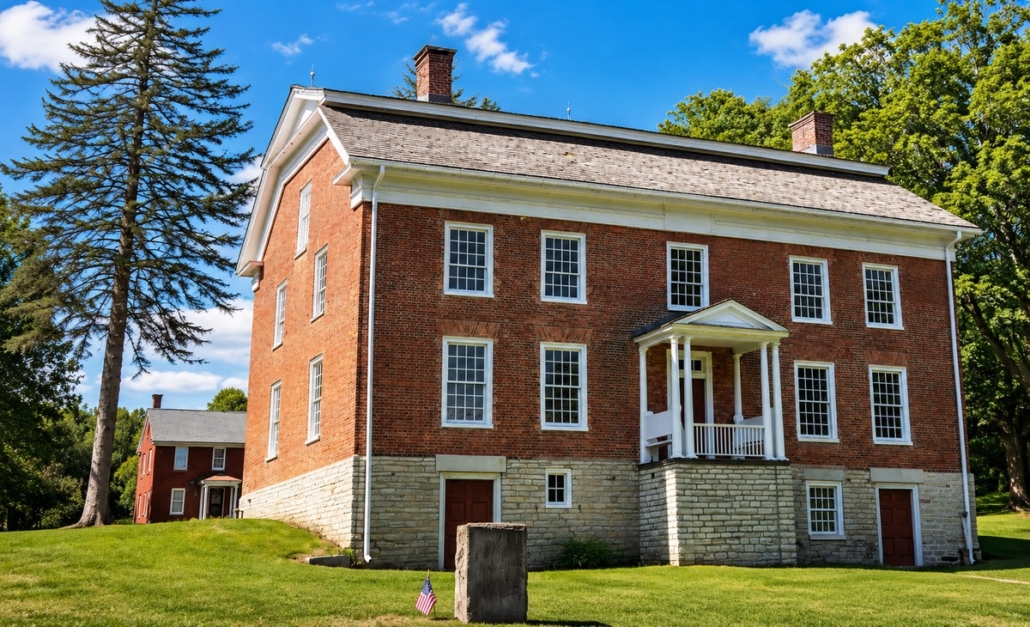
FIGURE 1.2
Rear Elevation, General Nicholas Herkimer Home.
Photograph © Elizabeth Spraker.
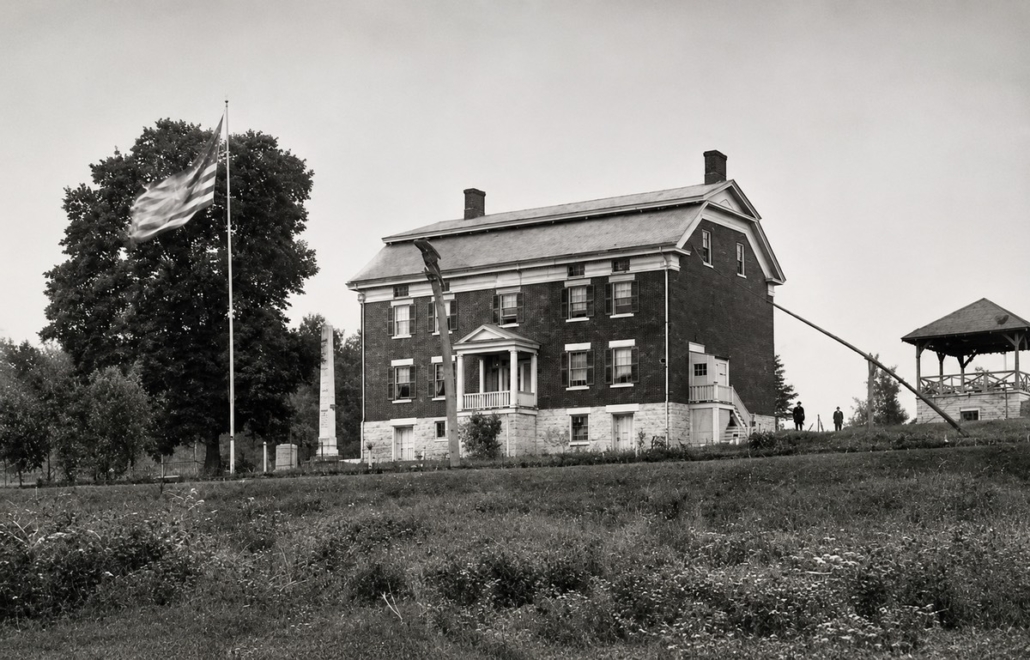
FIGURE 1.3
General Nicholas Herkimer Home, Historic View.
Courtesy of Little Falls Historical Society Museum.
LEGACY
The General Nicholas Herkimer Home preserves more than the memory of a Revolutionary War hero. It preserves the world that shaped him—a working agricultural estate, a close-knit frontier community, and a landscape where leadership was measured through responsibility, trust, and service.
Within these walls, Nicholas Herkimer was a farmer, landowner, neighbor, and respected leader long before history placed him on the battlefield at Oriskany. The courage remembered there had been formed through years of work, judgment, loyalty, and devotion to his community.
Today, the home and its surrounding grounds allow each generation to understand him more fully. Its enduring legacy rests in the connection between place and character—the quiet frontier home where a life of duty prepared one man to answer an extraordinary call.
Elizabeth Spraker is a member of the Little Falls Historical Society.
Published on July 28, 2026.
MVT Updates
 MVEDD Presents Refresh & Reuse Homesteading WorkshopJuly 28, 2026 - 7:44 am
- Homegrown in Herkimer County: Simple Summertime Salad Recipe by Rob CirilloJuly 27, 2026 - 11:14 am
 FIGURE 1.1 General Nicholas Herkimer Home, Herkimer Home State Historic Site. Photograph © Elizabeth Spraker.