
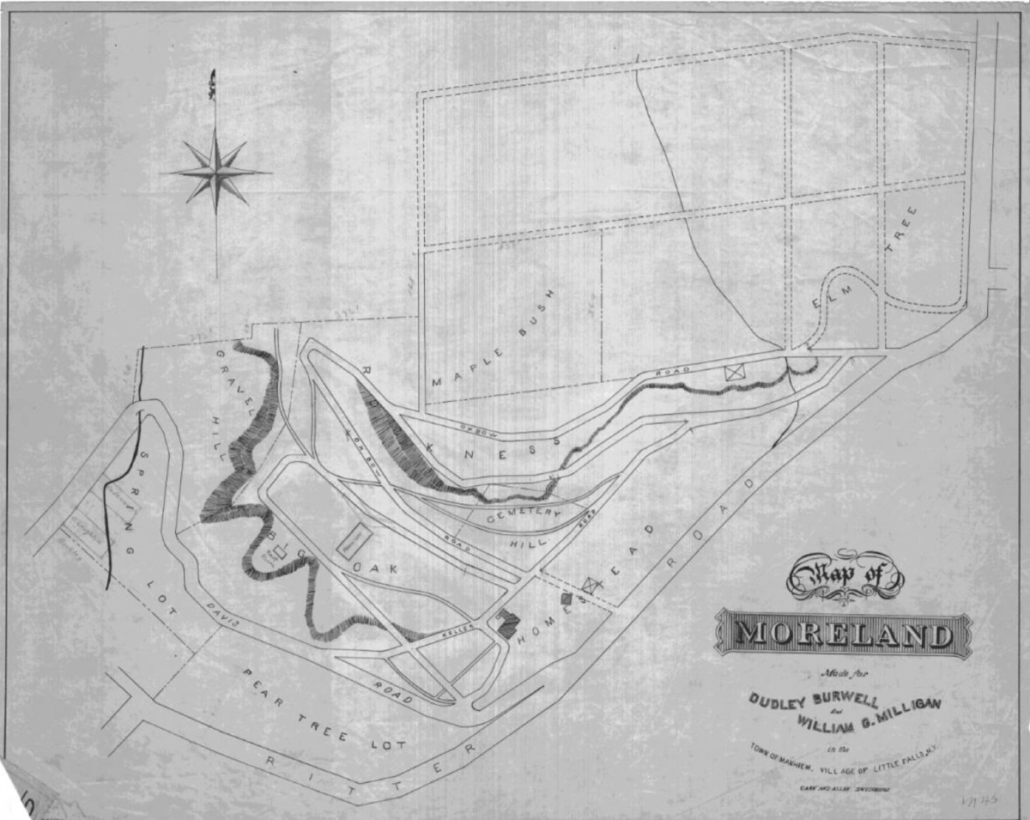
THE HERMIT OF BURWELL HILL POSTHUMOUS
As a side note, Frances Ledyard Haun, a Victorian authoress born in Little Falls in 1860, was the daughter of a long-standing Little Falls physician, Doctor Abram Haun. Two known pieces of her published literature were: “Auld Lang Syne”, a short story with the main character being Dudley Burwell, known as the Hermit of Burwell Hill, which was written in 1903, twenty-five years after the death of Burwell; and “The French Lover,” a short love story that takes place at Lake Bonaparte in the Adirondacks, which was written in 1915.
“Auld Lang Syne ” translates to “times long past / for the sake of old times’ and was originally the title to a poem written by the Scottish poet Robert Burns in 1788. It has since become a Scottish folk song usually sung at New Year’s, funerals, or as a farewell.
Frances spent her last years in a home for elderly women in Mohawk, New York, with her passing taking place on April 4, 1927. Frances Ledyard Haun was laid to rest beside her beloved parents in the Church Street Cemetery.
AULD LANG SYNE
Late one afternoon in December of ’73 I alighted from the train at a station in Central New York. The one hackman usually there was absent, so, leaving my valise in care of the baggage master, I started for my destination. Thro’ the small but attractive village I strolled, enjoying the crisp winter air, up thro’ a park, then by a grey stone academy, then as the houses grew more scattering I stopped to ask a small child my right direction. Pointing with her red mittened hand to a Gothic cottage upon a summit of a hill, she said, “There’s where he lives, sir.” Putting a coin in the tiny palm, I strode on up the hill – stopping on its brow to gain breath. I stood entranced – below me lay the Mohawk with its icy covering, here and there a party of skaters were gliding, while on either side rose hill upon hill like grim sentinels guarding the village at their base, while over all the last rays of the setting sun. Continuing my walk, I at last reached the cottage and, pausing for one parting look, as if by magic the sun disappeared, and the twilight fell.
In response to my knock, the door was open by a maid who showed me into a small reception room; pushing a chair to the old-time box stove, she said, “Please be seated, the master is about the grounds, I will send for him,” and taking my cards she left the room.
Settling myself comfortably in the big chair, I was soon nearly asleep, or I was more cold and weary than I had imagined. A touch upon my shoulder roused me and springing to my feet, I saw a gentleman of the old school, whose genial face and cordial manner bade me welcome. At his side a big dog stood, evidently his close companion. Taking his offered hand, I said, “Your pardon, Sir, I was weary and I fear asleep.” “No apology is necessary, your father’s son is very welcome; let me take your coat and cap, where is your baggage?” I explained the absence of hackman at the station, that I had left my valise there, and had walked up to call and bring my father’s message, and that I should go to Buffalo on the late train; than kind in you to take such a long cold walk to see a lonely old man. I will send for your valise, at least you will spend the night with me?”
Very willingly I consented, for I was weary, the wind was rising and it bid fair to be a cold night. The house was so cheerful, and my host so cordial, I had little desire to resume my journey. He seemed gratified at my decision.
After supper he ordered the stove filled with chunks of wood. Then, when a stand holding cigars and a pitcher of foaming cider had been placed between us, he dismissed the man, bidding him have extra care for the stock, for the night had grown intensely cold. Then, turning to me he said; “Now, tell me of your father and how he came to think of me, for it is years since I have heard of him.”
Then I told him of the evening when we were all looking over some old papers, how we found a letter announcing his marriage, dated years ago. Then father recollected his leaving the city and coming up here to locate. So, when I decided to come west he asked me to stop and make inquiries, and if he were living to go upon him for the sake of “Auld Lang Syne.”
For a moment he was silent, then, lighting his cigar, he said, “Draw your chair closer to the fire, Jack. Here the wind howl! It is seldom I talk much, but I should like to tell you a little of my life. When a boy, I was poor but ambitious. After a time by working early and late, I was enough ahead in funds to go what in those days was a fine college, seven miles north of here.” (Fairfield Academy)
“I was always given to moods, some days eager for fun, others gloomy and taciturn ; it was then I first met your father. I was irresistibly drawn toward him; his sunny face and winning ways made him a favorite and while he had hosts of friends, I counted mine on my fingers.
“After I acquired my profession, I went to the city and soon had a fair practice; then I began to go out into society. Fair women smiled upon me, delicate fingers lingered in mine, bright eyes grew brighter when I came. But often my strange moods would assert themselves and I would withdraw from all society and for months devote myself to my law practice.
“Finally, during a gay winter, I wooed and won a charming girl. Was she beautiful, you ask? I think so, Jack, any woman you love is beautiful to you. Possibly I was not fitted for a home, for often since I have thought a taciturn, reserved man like myself had no right to wed a bright young girl. God knows I meant to be kind to her, but I fear now she might have been lonely! But it was only for a brief time, and then she went up beyond the stars.
“Shortly after thro’ the successful termination of a law suit I earned an immense fee, then I bought this land, built the house at the foot of the hill and later on, this one, where since I have lived with my help and my dogs. Year in and year out, I have watched the sowing and the reaping, the budding of the trees and the drifting of the snows. In the summer my grounds are open to the public; merry picnic parties come and go; the laughter of children sounds thro’ the trees and I doubt not many a pair of lovers have plighted their troth, in the shady woods of mine.
“You ask if I’m lonely, Jack? Yes, I suppose I am, altho’ down in the village I have some friends, a banker, a physician and perhaps a few others.
“A few days ago, the Rector’s daughter (where I attend church it is the Episcopal) came to me. They were going to have a Christmas tree for the children, would I give her a small donation? It so happened on that morning, some boys had been cutting cedar trees on my grounds. I had been harsh with them, altho’ now I am sure they meant no harm. So, I answered the young lady shortly, that I didn’t believe in Christmas, that it was all nonsense, and they had much better buy coal for the poor, that I had nothing to give her.
“As she turned away, I was sure there were tears in her brown eyes, but she only said, ‘I’m sorry you feel that way, sir. I wish you had someone to make Christmas happy for you.’ All that day, matters went wrong, and when after supper I sat by the fire, I was a lonely, miserable old man.
“Possibly I fell asleep; suddenly the room grew bright. Many little faces hovered about me and I distinctly heard, ‘Except ye become as one of these, ye cannot enter the Kingdom of Heaven.’ Before I retired, I wrote a note to the young lady enclosing a bill and asking her to pardon my gruffness; soon a gracious acknowledgement came, saying her father would be glad if I would come Christmas Eve and see the happiness of the children.
“So, when the evening came, Barney and I went down. The Rector stood in the vestibule and greeted me cordially. I asked if Barney might enter, saying, ‘You know I believe my dog has a soul to save, as well as myself.’ “Certainly,’ he replied, ‘we all have a right to our own opinion’, and he himself took me to a seat, well down the church. Barney was well trained and placed himself decorously beside me.
“Right across from us sat the children, and I could not help but notice their happy faces. Presently the service began. After the prayers, the Rector, in a few well-chosen words told the old story of Christmas; then while the tree was being lighted, he gave out the hymn, ‘While Shepards Watched Their Flocks by Night’, saying the tune would be Coronation and let all the people sing.
“Opposite us sat a golden hair child who had been watching Barney and me with much interest; presently she came and offered me her book. Standing her upon the seat by me, I shared it and for the first time in years I sang, and ice around my heart began to melt.
“When the hymn was ended, I lifted her on my lap and together we saw the gifts distributed. Presently she slipped from my knee and with a beaming face, went to the tree. Returning with a large waxen doll she climbed into my lap, showed me the real hair, the shut-open eyes; then pressing her cornucopia of candy into my hand, said: ‘This is for you, I’ve lots more home.’ Soon I felt her lean heavily against me, the lids drooped over her blue eyes, with dolly hugged closely to her, she was asleep.
“At the close of the service the lady took the little tot, and thanking me said, ‘I fear you have found her a burden.’ I replied, ‘No, Madam, a blessing.’
“After speaking for a moment with the Rector and his daughter, and telling them of my interest in the service, we started for the hill. Much to my surprise I found the house trimmed with evergreen. Thanking the help for their kindness, they replied they were grateful for their gifts and so made free to do it, and now your coming has put the finishing touch to my holiday, and I am very cheerful.”
Just then the clock chimed eleven; he filled the stove and said, “You must be weary, Jack, I will show you to your room.” After making sure I had every comfort he bade me goodnight, saying, ‘When I look at you, I feel as if I had your father, and I was young again.”
The next morning when I came to breakfast the cold was intense, but the sun was shining and there was just enough snow to cover the ground.
As we rose from the table my host asked if I would like to go about the grounds with him. As I replied in the affirmative, the servant brought my coat and cap, putting on his circle cloak and taking his staff, the dog following, we started.
After the tour of the park, we walked up to the very brow of the hill. As we stood upon the eminence, my admiration of the view knew no bounds. Pointing to the valley below us he said: “Someday that village down there will be a thriving city, there will be fine school buildings, the hum of the mills will increase, and the street cars will pass to and fro. To that coming city I shall leave this park.”
Then laying his hand upon a monument he said: “Here I shall rest, as I have lived – far from the haunts of men. Under Catherine’s name shall be inscribed mine. There Jeff sleeps now; see the foot stone, ‘Old Jeff, a faithful dog, rests here, waiting for his master.’
“In my farm wagon, drawn by my own horses, all that is mortal of me shall be brought here; my own help shall lower me to my resting place, and shall seal the stone over me; then when the last trump shall sound, I shall rise, facing the east and that wonderful view I have loved so during life; but come, we must walk on. It is too cold for you to stand longer.”
In the afternoon I left. The man and sleigh were waiting so I said good-bye to him and told him what a pleasure it had all been to me. “Thank you, Jack, for your coming,” he replied, “I shall write your father and tell him how the gates of memory have swung wide for me, and how I have wandered once again in the fields of my boyhood. Goodbye, my boy. Come again, you shall be more than welcome.”
As we drove down the hill I turned to wave my cap at him, but he stood with his cloak wrapped about him, leaning on his staff gazing into the east, his faithful dog beside him, grand in his loneliness – The Hermit of Burwell Hill.
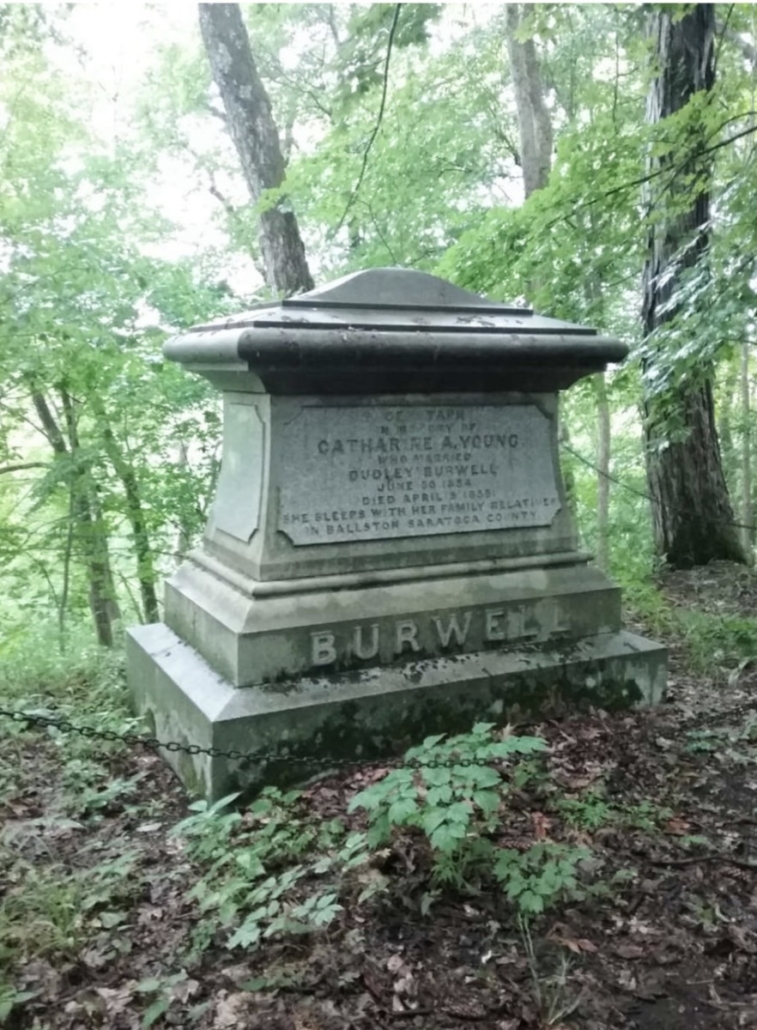
Inscription on Dudley Burwell monument. Photo courtesy of the Little Falls Historical Society.
NOTE: Upon his death, the Burwell Trust, containing both his home and the thirty acre grounds, designated Burwell’s friend William Millligan as executor. Upon Milligan’s death in January 1904, the City of Little Falls gained full control of the Burwell Trust. During the 1911 centennial celebration, Moreland Park and its pavilion were officially dedicated by Little Falls mayor Timothy Daisey and opened for public use in a daylong celebration event.
This was first published by the Little Falls Historical Society.
Published on August 26, 2026.
Support Mohawk Valley Today!

MVT Updates
 City of Amsterdam Recognizes Local Food Pantries for their Invaluable ServiceOctober 13, 2026 - 8:05 am
- Indigenous Peoples’ Day gathering to feature Fidel Moreno at Hartwick’s Pine LakeOctober 12, 2026 - 8:23 am
- Mohawk Valley Featured Weekend EventsOctober 9, 2026 - 8:45 am


Featured Events
 Image by Hartwick College
 Old Forge Library Grief Circle
















 GLOVERSVILLE LAUNCHES "CENTENNIAL CLUB" HONORING CENTURY-OLD BUSINESSES AND ORGANIZATIONS